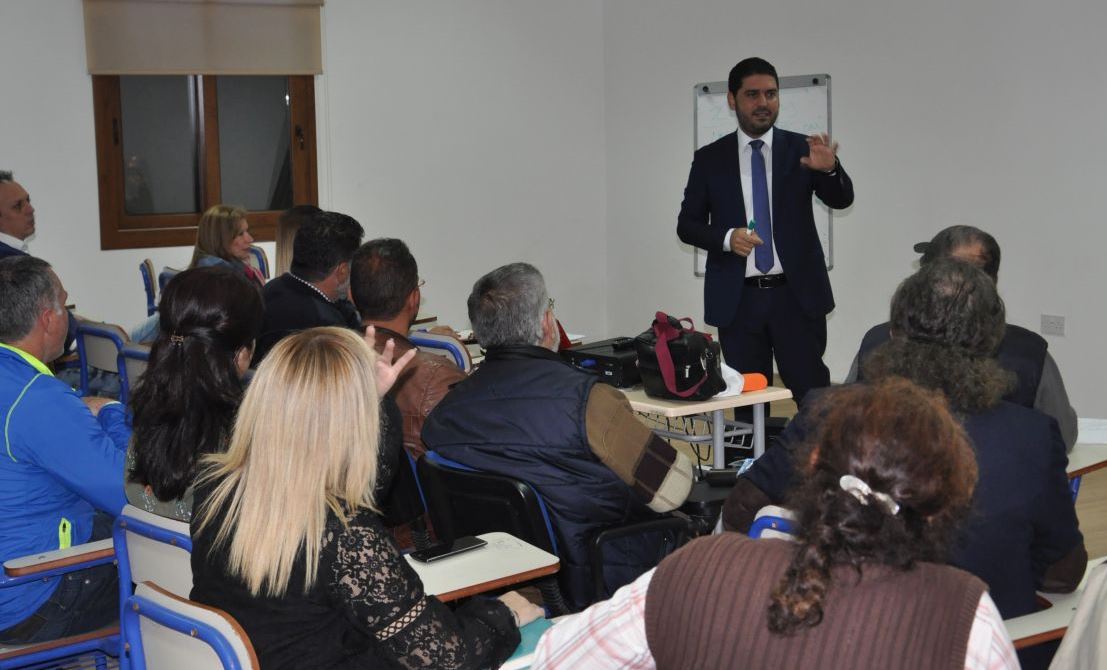
Within the scope of the trainings organized by the Ministry of Tourism and Environment at OTEM in order to train qualified workforce for the tourism sector, the seminar on “sustainable development and alternative tourism types” was given by Dr. Ahmet Savaşan, President of the Health Tourism Council.
Stating that throughout history people from different social and economic classes have taken part in tourism movements for various reasons, Dr. Ahmet Savaşan, pointed out that the phenomenon of tourism, which exists in various forms in people’s lives, has changed in parallel with social transformations. Savaşan explained that the process of change in the phenomenon of tourism can be described as Pre-Modern, Modern and Postmodern Tourism.
In the pre-modern period, travel was a right belonging to aristocrats…
Stating that social structure, technological developments, modes of production and the nature of the tourism market are effective in the development of the tourism phenomenon in the historical process, Savaşan said that in the pre-modern period, tourism was based on class differences in the social structure, limited technological developments were experienced and the tourism market was shaped in line with the individual demands of the upper class. Savaşan underlined that in this period, due to the fact that tourism awareness had not yet been formed in the society and the level of welfare was low, traveling for reasons other than compulsory reasons was seen as a right belonging to the noble and aristocratic classes.
In the modern period, tourism products appealed to the masses…
Explaining that modern thought, the foundations of which were laid during the Enlightenment period based on the superiority of human reason, caused a radical transformation with industrialization, Savaşan said that the modern period, in which the idea of massiveness came to the fore, was an important stage in social life. Stating that the modern period intensely affected the supply and demand for tourism and its effects have continued until today, Savaşan said that in the modern period, which was shaped towards the end of the 19th century, tourism products became increasingly standardized and appealing to the masses in parallel with the freedom to travel, increase in welfare, developments in employee rights, social security rights, technological developments, and accelerated urbanization. “In the shaping of the modern tourism phenomenon, especially the democratization of travel, developments in information and transportation technologies have given massiveness to tourism,” said Dr. Ahmet Savaşan, adding that the developments in transportation and information technologies after World War II caused tourism movements to gain momentum on an international scale.
In the postmodern period, individuality replaced massification…
Pointing out that in the postmodern period the individual replaced the masses at the focus of thought, and that the freedom and welfare of the individual came to the fore instead of universally valid principles or truths, Savaşan said, “On the other hand, in this new period, when the negative effects of mass production and consumption began to be felt intensely, the needs of postmodern individuals could no longer be met with standardized mass products.”
Environmental awareness has increased…
Pointing out that this new phenomenon, which is now called Postmodern tourism, has started to move rapidly from flexible mass demand and production to individual demand and production, Savaşan said that as a result, the concepts of environmental sensitivity and sustainability gained importance in the postmodern period, surreal and virtual experiences came to the fore, information and communication technologies were used at the highest level and an extremely individualized tourism industry was shaped.
The importance of sustainable development has been understood…
Pointing out that the world economy today is in search of rebuilding a sustainable economy and life against the risk of global warming and climate change, which emerges as a natural consequence of environmental destruction, Dr. Ahmet Savaşan emphasized that sustainable development in this context represents a very important step towards a more efficient use of natural resources and a safer life in the future.
Exciting, educational and entertaining tourist products are in demand…
Stating that it is impossible for the tourism sector to stay out of this change, Dr. Ahmet Savaşan, underlined that the variety of tourism products, which traditionally began with sea-sun-sand, has today turned into the exciting-educational-entertaining.
Both the travel and the health trend will increase…
Stating that more than 1.2 billion people travel across borders every year, Dr. Ahmet Savaşan, stated that tourism is an important force for intercultural dialogue, peace, reconciliation and sustainable development. Explaining that people today try to regain the health they lose in busy work and city life at back-to-nature and back-to-oneself camps that include beauty and care treatments, massage, aromatherapy, fitness, yoga and pilates, Savaşan said that health tourism has been in vogue in recent years. Savaşan also stated that many studies show that both travel and health trends will gain even more importance in the coming years.
Health tourism has reached a volume of billions of dollars…
Stating that health tourism is divided into three main groups as advanced age and disabled, Thermal, SPA/Wellness and Medical tourism, Savaşan said that the health tourism sector, which is growing day by day, has reached a volume of billions of dollars.
The TRNC’s foreign trade deficit is covered by tourism…
Underlining that nearly half of the TRNC’s total foreign exchange revenues are obtained from tourism, Dr. Ahmet Savaşan, pointing out that the sum of tourism revenues in our country (700 million USD) and the revenues obtained within the scope of educational tourism (700 million USD) is 1.4 billion USD, emphasized that this figure covers the TRNC’s foreign trade deficit.
Responsibility, health, business and holiday tourism will make their mark…
For 2018, international travel will be dominated by Generation Y (those born between 1980 and 2000), Savaşan said, adding that “in the coming period, we will see women traveling alone, gastronomy, adventure, responsible tourism, mobile photography, health, business and holiday tourism developing rapidly.”
Health tourism is shifting to developing countries…
Stating that in recent years, travel for health tourism purposes has intensified from developed countries to developing countries, Savaşan said: “The world population has aged, the weight of chronic diseases in the burden of disease has increased and treatment costs have led people and even countries to health services to be received in countries with lower costs.”
We must give importance to health, congress, gastronomy, cruise and eco-tourism…
Stating that health tourism is a market that especially developing countries attach importance to today, Savaşan said, “In order to develop the country’s tourism and increase the domestic value added by making it sustainable, we need to try to attract international health tourists by diversifying our health-related products and services in strategic product positioning while trying to increase our existing mass tourism revenues, accelerate our work in areas such as congress, eco, gastronomy, which are preferred more and more by qualified tourists every day, and carry out the necessary work to enter the cruise tourism market.”