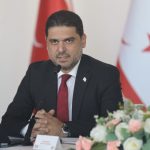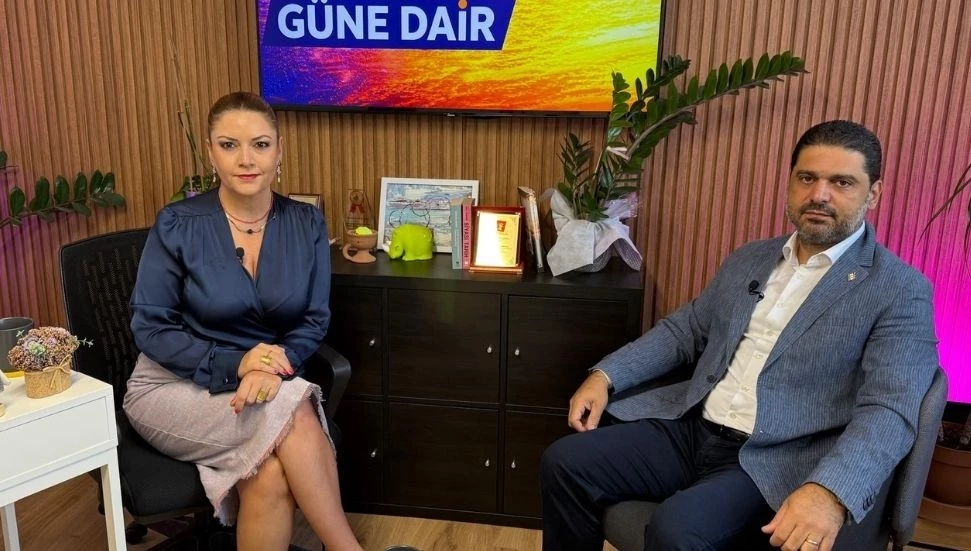
UBP Secretary General Ahmet Savaşan answered questions on the hot topics of the agenda on the live broadcast Güne Dair with Nazar Erişkin, ranging from the election calendar to the mixed-voting debate, and from the government’s performance record to the fake diploma and IVF scandals.
Ahmet Savaşan’s appearance on Güne Dair, beyond the election date, UBP’s performance in government; the timing of the mixed-vote abolition, differing voices within the party, the government’s “achievements” rhetoric, the oversight capacity of public administration, the loss of reputation in higher education and the political responsibility for the crises in health tourism were all discussed together. While defending the government’s performance in reform and law-making, Savaşan acknowledged that the problems in both higher education and health had damaged Northern Cyprus’s brand value and that state oversight needed to be strengthened.
UBP Secretary General Ahmet Savaşan, gave a clear date regarding the election calendar on the Nazar Erişkin ile Güne Dair programme broadcast on digital platforms. Savaşan stated that the decision to hold the general election and local elections together on 6 December 2026 had passed the Council of Ministers, and said the decision would be brought to the agenda at the first session of the Assembly’s new legislative year.
Savaşan said the coalition partners had also reached common ground on holding the two elections together, and that the Council of Ministers’ decision was a sign of this.
Responding on the programme to criticism that the abolition of mixed voting shortly before the election was linked to UBP’s internal election calculations, Savaşan argued that UBP’s decision on this matter dated back years. However, Savaşan also openly acknowledged that there were MPs within UBP who opposed the abolition of mixed voting.
Stressing that the Party Assembly’s decision is binding, Savaşan said they had initially aimed for unanimity in the Assembly on abolishing mixed voting, but that this had not materialised. Regarding the current picture, Savaşan said: “It looks like it will pass by majority vote.”
Arguing that mixed voting adversely affects how the will of voters is reflected at the ballot box, Savaşan said that in the last general election a significant proportion of those who cast mixed votes had their votes declared invalid. He also claimed that the mixed system led to electoral cooperation between candidates from different parties and harmed the sense of unity within parties.
FAKE DIPLOMAS: “IT HAS DAMAGED THE COUNTRY’S BRAND VALUE”
The loss of reputation suffered recently by higher education in Northern Cyprus due to fake diploma investigations was also addressed on the programme in terms of political responsibility. Nazar Erişkin recalled that in the investigation names linked to UBP had also surfaced, and asked: “Isn’t overseeing higher education also the responsibility of the political government?” In response, Savaşan argued that a legal distinction must be made between a “fake diploma” and an “invalid diploma”, while acknowledging that what had happened had damaged higher education in Northern Cyprus: “This issue has tarnished our image as an island of universities. That is certain.”
Saying that oversight mechanisms need to be stronger, Savaşan stated that YÖDAK should be strengthened and universities made more transparent and auditable.
IVF SCANDAL: THE STATE’S OVERSIGHT RESPONSIBILITY AT THE CENTRE OF THE DEBATE
One of the most critical topics of the programme was the serious allegations about IVF centres in Northern Cyprus reported in the international press.
Savaşan stated that IVF is one of Northern Cyprus’s strongest fields in terms of health tourism and argued that the sector must be protected.
Regarding the latest report published by the BBC, he pointed out that the centre targeted by the report is an institution that brings a very large number of patients from the United Kingdom, and expressed the view that behind the incident there may be attempts aimed at reducing Northern Cyprus’s share of health tourism.
Nevertheless, Savaşan also said that the state’s responsibility is indisputable: “Whoever it may be, whichever health institution it may be, it must not act contrary to the law. If it has, it must bear the consequences.”
Saying that following the latest allegations the Ministry of Health had placed all IVF centres under re-examination in addition to routine inspections, Savaşan stated that he expected the Ministry to make a statement to the public shortly. The programme also emphasised that responding to international reports solely with the rhetoric of an “attack from outside” is not enough, and questioned whether fast, transparent and effective state oversight, with results shared with the public, was being carried out in response to the allegations.