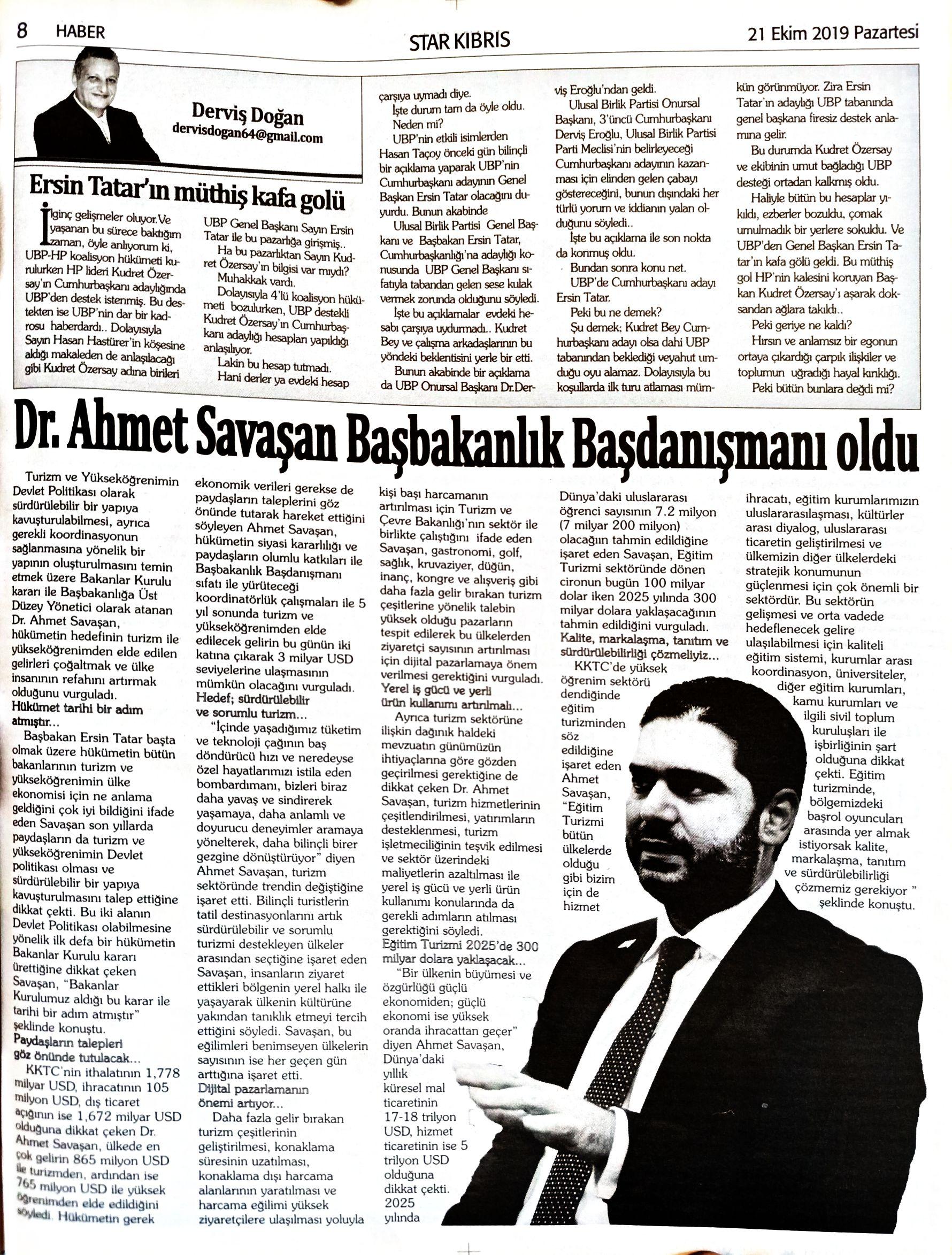
Dr. Ahmet Savaşan, who was appointed as a Senior Executive at the Prime Minister’s Office with the decision of the Council of Ministers in order to ensure that tourism and higher education have a sustainable structure as a State Policy and to ensure the establishment of a structure to ensure the necessary coordination, emphasized that the government’s goal is to increase the revenues from tourism and higher education and to increase the welfare of the people of the country.
The government has taken a historic step…
Stating that all the ministers of the government, led by Prime Minister Ersin Tatar, know very well what tourism and higher education mean for the country’s economy, Savaşan pointed out that in recent years stakeholders have also been calling for tourism and higher education to become state policy and to be given a sustainable structure. Noting that, for the first time, a government has produced a Council of Ministers decision for these two fields to become State Policy, Savaşan said, “With this decision, our Council of Ministers has taken a historic step.”
The demands of stakeholders will be taken into account…
Pointing out that the TRNC’s imports stand at 1.778 billion USD, its exports at 105 million USD and its foreign trade deficit at 1.672 billion USD, Dr. Ahmet Savaşan said the country’s largest source of income is tourism with 865 million USD, followed by higher education with 765 million USD.
Stating that the government is acting by taking into account both the economic data and the demands of the stakeholders, Ahmet Savaşan emphasized that with the political determination of the government and the positive contributions of the stakeholders and the coordination work to be carried out with the title of Chief Advisor to the Prime Minister’s Office, it will be possible to double the income from tourism and higher education to 3 billion USD by the end of 5 years.
The goal: sustainable and responsible tourism…
Saying, “The dizzying pace of the age of consumption and technology we live in, and its bombardment that has all but invaded our private lives, are turning us into more conscious travellers by leading us to live a little more slowly and deliberately and to seek more meaningful and fulfilling experiences,” Ahmet Savaşan pointed out that the trend in the tourism sector has changed.
Pointing out that conscious tourists now choose their holiday destinations among countries that support sustainable and responsible tourism, Savaşan said that people prefer to witness the culture of the country closely by living with the local people of the region they visit. Savaşan pointed out that the number of countries adopting these trends is increasing day by day.
The importance of digital marketing is increasing…
Stating that the Ministry of Tourism and Environment is working with the sector to increase per capita spending by developing types of tourism that generate more revenue, extending the length of stay, creating areas of spending outside accommodation and reaching visitors with a high propensity to spend, Savaşan emphasised that importance should be given to digital marketing in order to identify markets with high demand for higher-revenue types of tourism such as gastronomy, golf, health, cruise, wedding, faith, congress and shopping tourism, and to increase the number of visitors from these countries.
The use of the local workforce and local products must be increased…
Dr. Ahmet Savaşan also pointed out that the scattered legislation on the tourism sector should be revised according to today’s needs, and said that necessary steps should be taken to diversify tourism services, support investments, encourage tourism management, reduce costs on the sector, and use local labor and local products.
Education Tourism will approach 300 billion dollars in 2025…
Saying, “A country’s growth and freedom depend on a strong economy, and a strong economy depends on a high level of exports,” Ahmet Savaşan pointed out that annual global trade in goods in the world amounts to 17-18 trillion USD and trade in services to 5 trillion USD.
Pointing out that the number of international students in the world is estimated to reach 7.2 million in 2025, Savaşan emphasised that the turnover in the Education Tourism sector, which is 100 billion dollars today, is estimated to approach 300 billion dollars in 2025.
We must solve quality, branding, promotion and sustainability…
Pointing out that when the higher education sector is mentioned in the TRNC, educational tourism is mentioned, Ahmet Savaşan said, ‘Educational Tourism is a very important sector for us, as in all countries, for the export of services, internationalization of our educational institutions, intercultural dialogue, development of international trade and strengthening the strategic position of our country in other countries. He pointed out that a quality education system, inter-institutional coordination, cooperation with universities, other educational institutions and relevant non-governmental organizations are essential for the development of this sector and to reach the targeted income in the medium term. If we want to be among the leading players in education tourism in our region, we need to solve quality, branding, promotion and sustainability.